Project at a glance
Bellaria Kino, Museumstrasse 3, Vienna (Austria) - Founded 1911. Reopened 2026.
Year established
Years in restoration
Red velvet Ezcaray seats
Technology partners
There are cinemas, and then there are institutions. The Bellaria, tucked behind Vienna's Volkstheater on Museumstrasse, is firmly the latter. Opened in 1911, it spent much of the twentieth century as a cultural touchstone, drawing loyal afternoon audiences for interwar and postwar film classics, and nurturing a quieter but equally devoted arthouse crowd in the evenings. When longtime operator Erich Hemmelmayer stepped down in late 2019, citing economic pressures, the Bellaria fell dark. For a city that prides itself on its living relationship with cinema, the loss was keenly felt.
More than 5 years on, the Bellaria is back. On 16 April 2026, the cinema reopened under new ownership - a collaboration between film distributors and cinema operators Sophie and Michael Stejskal (who also run the De France and Votivkino cinemas), alongside Lisa Stolze handling marketing, and hospitality partners Moritz Baier and Daniel Botros of Café Liebling, who have taken over the venue's newly redesigned bar. The restoration was painstaking: heritage protections, a global pandemic, and a series of last-minute technical complications pushed the originally planned 2022 opening back by four years. But the result was worth the wait.
At the heart of the technical transformation - turning a much-loved but ageing single-screen venue into a state-of-the-art boutique cinema while preserving every inch of its character - was CinemaNext’s Austrian team.
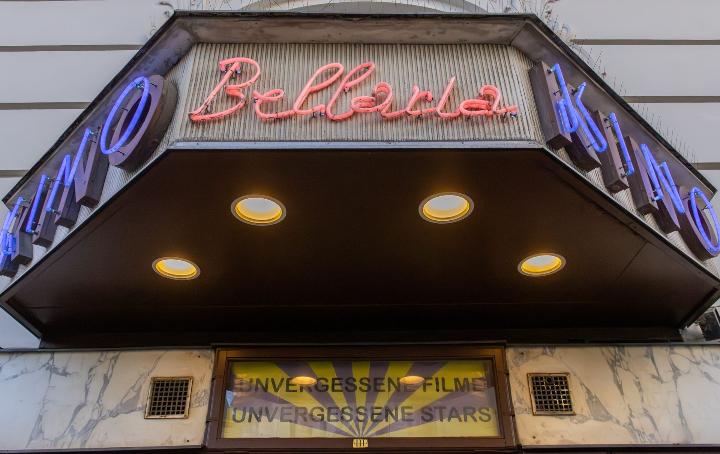
Photo credit: (c) Stefanie Weberhofer
The challenge: respecting the past, enabling the future
Renovating a listed heritage building for modern cinema exhibition is never straightforward. Parts of the Bellaria are formally protected: the ornate foyer lamps, the glass display case clasps on the façade, the iconic curved lettering above the entrance. The famous floral wallpaper in the foyer was deliberately retained. The task for CinemaNext was to deliver a complete, contemporary technical installation that would be invisible in the best possible sense: transformative for the experience, imperceptible to the eye.
For a building that had never previously had a ventilation system or professional soundproofing, let alone a dedicated projection booth, installing this was no small undertaking. CinemaNext's installation team worked to integrate a full boothless projection setup, threading state-of-the-art cinema equipment seamlessly into the fabric of a building that opened when silent films were still the norm.
"In principle, it would have been cheaper to tear everything down and build completely new. But that was naturally not an option."
— Michael Stejskal, co-owner, Bellaria Kino
The technology: precision tools for a boutique screen
The centrepiece of CinemaNext's installation is a Barco SP2K7 laser projector, a compact, efficient, and high-performance unit ideally suited to the Bellaria's intimate 123-seat auditorium. Deployed in a boothless configuration using CinemaNext’s P-SBOX hushbox, the SP2K7 delivers crisp, bright 2K imagery without the infrastructure demands of a traditional projection booth, an approach that proved essential given the building's heritage constraints and spatial limitations. The result is a picture quality that would have been unimaginable to the cinema's original audiences, delivered with an unobtrusiveness that respects every detail of the restored interior.
The sound was equally critical. CinemaNext specified and installed JBL speakers & amplifiers, bringing professional-grade audio to a space that previously had no acoustic isolation to speak of. The new soundproofing, another first for the Bellaria, works in concert with the JBL cinema system to create an enveloping sonic environment that enhances every genre the cinema plans to programme, from whisper-quiet arthouse drama to richly scored film classics.
Completing the audience experience is the seating, supplied by Ezcaray. The 123 red velvet Bruselas seats, brand new and impeccably comfortable, manage the considerable feat of feeling both contemporary and entirely in keeping with the Bellaria's historic character. For a venue whose owners are acutely aware that their older audience must feel welcomed rather than alienated, the choice of seating was far from a minor detail.
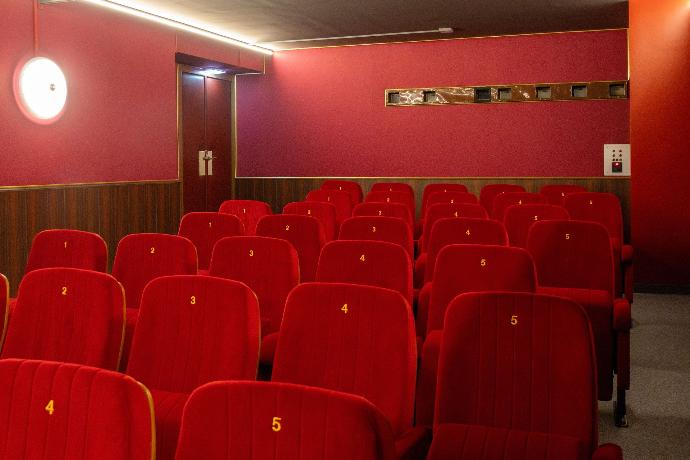

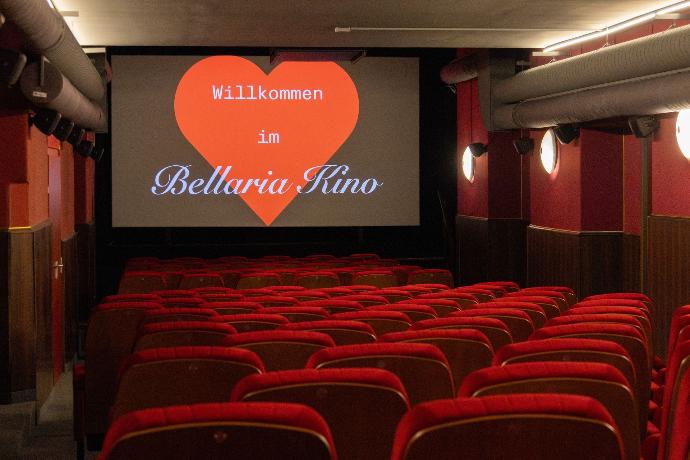

Photo credit: (c) Stefanie Weberhofer
TECHNOLOGY SPECIFICATION
Projection: Barco SP2K7 boothless installation, 2K digital cinema
Sound: JBL speakers & amplifiers
Seating: Ezcaray Bruselas seats
Format: CinemaNext P-SBOX boothless projection — heritage-sensitive installation
Capacity: 123 seats, single screen
A boutique vision, delivered
The Stejskals describe the new Bellaria as a "boutique cinema", and every aspect of the refurbishment reflects that ambition. The popcorn machine was ordered deliberately in black rather than classic American-diner red, because it "suits the character of the space better." The bar, now run by Baier and Botros, has been designed to draw visitors outside of screening hours, anchored around a house cocktail: the still-secret Bellaria Spritz. The black-and-white photographs of film stars that once lined the foyer were lost to time, but the spirit they represented - a love of cinema as culture, not just entertainment - has been meticulously preserved.
The programming philosophy follows the same logic. The new Bellaria intends to be a repertory cinema, mixing current arthouse releases with film classics approached from an international rather than purely nostalgic perspective. Original-language screenings with German subtitles will be the default, though the team is thoughtfully considering the preferences of an older audience that may prefer dubbed versions, a nuance that speaks to how carefully the owners are listening to their community.
"We first have to get to know our audience, but we know they'll come. The young, the middle-aged, and older audiences. They may not go to the same films, but they all come."
— Sophie Stejskal, co-owner, Bellaria Kino
Cinema's quiet renaissance
The reopening of the Bellaria arrives at a moment the Stejskals characterise as a genuine "renaissance" for cinema. While multiplexes continue to concentrate on blockbusters, arthouse audiences, across all age groups, are, in their words, spread "very pleasantly" across a wide range of titles. Vienna's cinema landscape, by their assessment, is on solid footing.
For CinemaNext, the Bellaria project represents something that goes beyond a standard installation brief. It is a demonstration of what is possible when technical expertise, sensitivity to heritage, and a shared commitment to the future of exhibition come together around a building that genuinely matters. In a city that takes its cinemas seriously, the return of the Bellaria is cause for real celebration.
The 123 red velvet seats are waiting. The Barco projector is powered up. The JBL system is tuned. And somewhere in the foyer, that iconic floral wallpaper is still on the wall, as it has been for generations - a small, deliberate reminder that the best things, given the right care, endure.
How CinemaNext Helped Bring Vienna's Beloved Bellaria Back to Life