The Hungarian State Opera House in Budapest stands as one of the most impressive and beautiful of all the opera houses in Europe. Opening its doors to the public in 1884 after nine years of construction, the building on Andrássy Avenue has long been a jewel of Hungarian cultural heritage. More recently, after almost five years of full reconstruction, the curtain rose again on 12 March 2022 with a spectacular gala performance in the renovated Ybl Palace.
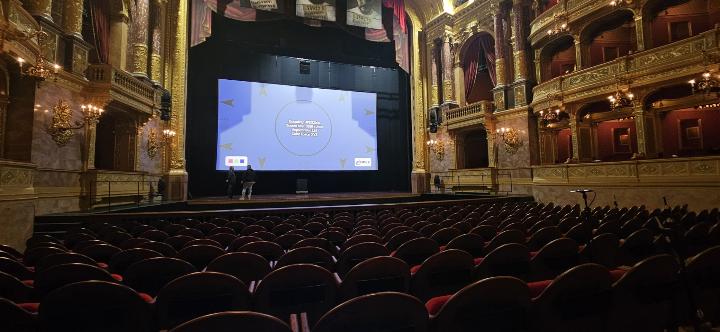
In early February 2026, this historic venue presented a unique opportunity: hosting a one-night-only film screening of Maria, Pablo Larraín's biographical film about Maria Callas. The choice of location was particularly fitting, as the film was shot mainly in Hungary, with authentic interiors captured at the Opera House itself and the Liszt Ferenc Academy of Music.
Technical Excellence in a Historic Setting
CinemaNext Hungary is a renowned special screening provider that has transformed numerous locations into cinemas for film premieres and special events, such as the Budapest Classic Film Marathon’s outdoor screening in downtown Budapest, in front of St. Stephen's Basilica, every autumn for eight years.
CinemaNext provided the full technical support for this evening, facing the distinctive challenge of delivering cinema-quality presentation within a 19th-century opera house. The solution combined the venue's existing sound infrastructure with dedicated cinema equipment, carefully configured to respect the Opera House's outstanding natural acoustics.
The local system consisted of K-Array KP102 column speakers for left and right channels, paired with Thunder KMT21 subwoofers. CinemaNext extended this LR + LFE foundation with two dedicated centre channel configurations - one serving the orchestra level and another for the dress and upper circles - ensuring consistent dialogue clarity throughout the auditorium's tiered seating. Additional effect speakers were installed in two unused boxes to complete the surround field.
A Galileo processor provided setup, initial alignment and basic delay for the Meyer Leopard stacks and UX40s, delivering precisely pre-tuned 5.1 channels to the Dolby CP950 Cinema Processor. The CP950 then controlled the whole auditorium as a cinema space, aligned with a six-microphone electroacoustic configuration to ensure precise tuning that worked with, rather than against, the Opera House's remarkable acoustic properties.
Picture-Perfect Presentation
The picture itself matched the audio quality. A Christie CP4435-RGB laser projector delivered accurate colour reproduction on a screen close to 12 metres wide, set within the 13.2-metre proscenium stage. This did justice to the cinematography of Edward Lachman, whose work on Maria earned him an ASC Award in 2025.
The universal sentiment from attendees was clear: the film sounded exceptional, and the audience enjoyed the screening immensely. When you begin with acoustics that score 10 out of 10 and add carefully considered cinema technology, the results speak for themselves.
Next-Level Screening at the Hungarian State Opera