Cinema Audio Systems and Sound Solutions
CinemaNext supplies comprehensive cinema audio systems to theatre operators across Europe. Our portfolio encompasses speakers, amplifiers, processors, and assistive listening technology for both traditional surround sound and immersive audio formats including Dolby Atmos and DTS, as well as audio networking solutions from Q-SYS.
What Cinema Speaker Systems Does CinemaNext Supply?
CinemaNext provides cinema loudspeakers from leading manufacturers including MiT (formerly QSC), JBL, Dolby, and MAG Cinema. The speaker portfolio covers screen channel speakers (left, centre, right behind the screen), surround speakers for side and rear wall mounting, subwoofers for low-frequency effects, ceiling speakers for immersive audio as well as optional surround bass management and public address systems for pre-show announcements and emergency communication.
The MiT (formerly QSC's) Digital Cinema Series (DCS) includes the Reference Monitor System for premium installations and the SC series (SC-1120, SC-1150) for high-performance applications. These shallow-depth cabinets are optimised for installation behind perforated cinema screens whilst maximising auditorium floor space. JBL's Cinema Expansion Series provides cost-effective solutions for venues requiring professional cinema sound at accessible price points, with rigging systems designed for flexible mounting including Dolby Atmos overhead speaker configurations.
For immersive audio installations, CinemaNext supplies overhead and height speakers specifically engineered for object-based sound formats. Dolby's SLS (Screen Loudspeaker System) and surround speakers deliver the precise directivity and power handling required for Dolby Atmos cinema presentations, whilst MAG Cinema systems provide clarity across venues of varying sizes.
Cinema Audio Processors and Immersive Sound
CinemaNext's cinema processor range centres on Dolby's CP950 Cinema Processor for full Dolby Atmos installations, capable of rendering up to 64 individual speaker feeds with Dolby Lake EQ and 1/12th octave equalisation. The CP950 Base provides upgrade paths from traditional 5.1 and 7.1 surround configurations. QSC's Q-SYS platform offers integrated processing solutions combining cinema decoding, crossover management, and system control in networked audio architectures.
These processors handle surround sound formats including Dolby Digital, Dolby Atmos, DTS, and DTS:X, with support for both DCI-compliant digital cinema servers and alternative content sources. Processing features include bass management, speaker alignment, acoustic correction, and format conversion for various programme types from theatrical releases to alternative content events.
Cinema Amplifiers and Power Distribution
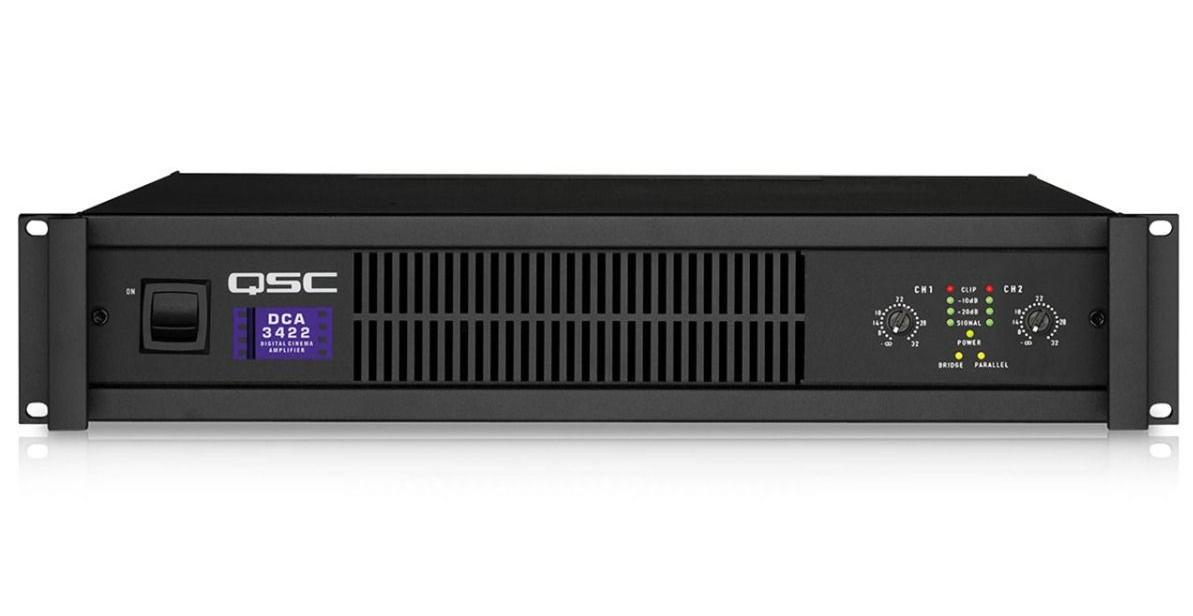
CinemaNext supplies both analogue and network-based cinema amplifiers. QSC's DCA (Digital Cinema Amplifier) series provides multi-channel amplification via DataPort connectivity, integrating with Q-SYS processors for simplified system wiring and comprehensive monitoring. Dolby's multichannel amplifiers deliver efficient power distribution whilst minimising heat generation and rack space requirements. CinemaNext has also had major experience in installing Crown amplifiers.
Network amplifiers utilise digital audio transport protocols (AES67, Dante, AVB) for flexible signal routing and remote monitoring. These systems reduce copper cabling requirements whilst enabling centralised system management across single-screen venues and multiplex installations. Amplifier selections match speaker power requirements from compact screens through large-format auditoriums, with configurations supporting 2-channel to 16-channel operation.
Digital Crossovers and Audio Monitoring
CinemaNext offers digital crossovers including QSC's DCM Series, which combine crossover functions with booth monitoring capabilities. These units provide frequency division for screen speakers, surround zones, and subwoofers, with time alignment and equalisation for each output. When paired with QSC's Intrinsic Correction DSP settings, these crossovers optimise matched speaker systems for consistent performance across installations.
Booth monitor systems include both active and passive speakers for projection booth or control room listening, enabling operators to verify programme audio without entering the auditorium. Multichannel monitoring solutions support immersive format verification during installation and ongoing system checks.
Audio Converters and Format Adaptation
CinemaNext maintains inventory of digital-to-analogue (D/A) and analogue-to-digital (A/D) converters for cinema applications. These handle format bridging between digital cinema servers, legacy analogue equipment, and modern network audio systems. Converters support AES/EBU, S/PDIF, and analogue balanced audio, ensuring compatibility across equipment generations and enabling gradual system upgrades without complete infrastructure replacement.

Assistive Listening and Accessibility Systems
CinemaNext supplies hearing impaired (HI) and visually impaired (VI) systems, along with closed caption (CCAP) solutions, including WatchWord in the UK and the GRETA app, for which it is the exclusive supplier in France, as well as the Sennheiser mobile connect and the corresponding app in The Netherlands. These assistive technologies use a variety of protocols to deliver audio include infrared wireless, transmitters and receivers for wireless audio delivery to hearing-impaired patrons, narrative audio feeds for vision-impaired guests, and caption display systems meeting accessibility requirements across European territories. Systems integrate with cinema processors for automated control synchronised with show times and content.
Audio Accessories and Infrastructure
CinemaNext's audio accessories encompass equipment racks and rack-mount hardware, speaker brackets and rigging systems, audio cables (balanced XLR, unbalanced, digital), format adapters, and signal distribution electronics. The accessories range includes tools for system calibration, acoustic measurement microphones, and test equipment for cinema audio specification verification.
Complete spares availability for MiT (QSC), JBL, Dolby, and MAG equipment ensures rapid service response. Consumables include replacement components for amplifiers, processors, and speakers, supporting long-term system operation without extended downtime.
Q-SYS Audio Networking and Integrated Control
CinemaNext implements QSC's Q-SYS Ecosystem for networked cinema audio solutions. Q-SYS replaces traditional analogue audio distribution with digital audio transport over standard network infrastructure, enabling centralised control, comprehensive monitoring, and simplified cabling across single-screen venues and multiplex installations.
The Q-SYS Core series processors (including the Core 510i for larger cinema venues) provide cinema audio decoding, digital signal processing, crossover management, and system control within a single networked platform. These cores support AES67, Dante, and other audio-over-IP protocols, allowing integration with diverse audio equipment whilst maintaining low latency required for cinema synchronisation.
Q-SYS Cinema I/O peripherals include the DCIO-H (Digital Cinema Input/Output with HDMI), which provides HDMI pass-through for video whilst extracting audio and bitstream decoding of both Dolby and DTS formats for processing, plus 16-channel AES digital inputs for DCI-compliant servers from Barco, Dolby, and GDC. These peripherals distribute across the network, positioning I/O interfaces precisely where needed rather than centralising all connections.
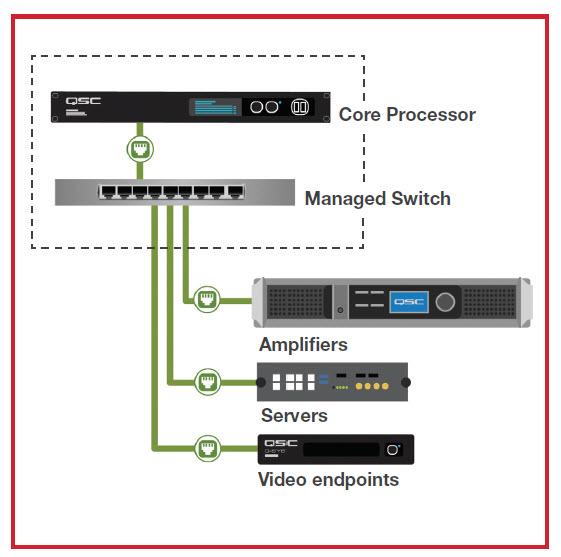
Network amplifiers in the Q-SYS ecosystem receive audio via QSC's Q-LAN network protocol, eliminating traditional analogue audio cabling between processors and amplifiers. This digital distribution maintains signal integrity whilst enabling real-time amplifier monitoring, thermal management, and fault reporting through the centralised control interface. For multiplex operations, Q-SYS allows single-point management of audio systems across multiple auditoriums, with customisable user interfaces for booth operators and technicians.
Q-SYS Designer Software provides graphical programming for custom cinema workflows, integrating audio processing with lighting control, masking systems, automation relays, and third-party equipment via GPIO, RS-232, and network protocols. This programmability enables venue-specific solutions from simple single-screen operations through complex multiplex and premium large format installations requiring sophisticated show control sequences.
Why Choose CinemaNext for Cinema Audio Systems?
CinemaNext has established partnerships with Dolby, QSC, MiT, JBL, and MAG Cinema, securing competitive pricing and technical support for clients across Europe. Our audio specialists advise on system design matching auditorium acoustics, screen size, seating capacity, and format requirements from traditional 5.1 through Dolby Atmos configurations up to 64 discrete channels.
From specification and acoustic modelling through installation, calibration, and ongoing maintenance, we provide complete lifecycle support for cinema audio systems. Whether you're designing a new multiplex, upgrading to immersive audio, or maintaining existing installations, CinemaNext's audio team can guide you through technology selection and system optimisation for your venue's specific requirements.
Cinema Audio Systems: Frequently Asked Questions
What audio equipment is needed for a Dolby Atmos cinema installation?
A complete Dolby Atmos cinema installation requires a Dolby CP950 Cinema Processor (capable of rendering up to 64 speaker feeds), screen channel speakers (left, centre, right), surround speakers for side and rear walls, overhead speakers for height channels, subwoofers for low-frequency effects, multichannel amplification, and assistive listening systems. The exact speaker count depends on auditorium size, with typical configurations ranging from 9.1 channels for smaller screens to 64+ discrete channels for premium large format installations. CinemaNext supplies complete Dolby Atmos packages including Dolby processors, speakers from MiT (formerly QSC), JBL, Dolby SLS, and MAG Cinema, amplifiers, and integration services.
Which cinema speaker brands does CinemaNext recommend?
CinemaNext supplies cinema speakers from MiT (formerly QSC), JBL, Dolby, and MAG Cinema. MiT's Digital Cinema Series (DCS) offers the Reference Monitor System for premium installations and SC series speakers (SC-1120, SC-1150) for high-performance applications. JBL's Cinema Expansion Series provides cost-effective professional sound with Dolby Atmos compatibility. Dolby's SLS speakers are specifically engineered for Dolby Atmos installations. MAG Cinema systems suit various auditorium sizes. Brand selection depends on budget, auditorium acoustics, and format requirements.
What is Q-SYS and how does it work in cinemas?
Q-SYS is QSC's networked audio ecosystem that replaces traditional analogue audio cabling with digital audio transport over standard network infrastructure. In cinema applications, Q-SYS Core processors (including the Core 510i for larger cinema venues) handle audio decoding, signal processing, crossover management, and system control through a single networked platform. Audio travels digitally to network amplifiers via QSC's Q-LAN network protocol, eliminating analogue cable runs whilst enabling real-time monitoring and centralised control. For multiplex operations, Q-SYS manages audio across all auditoriums from a single interface, reducing installation complexity and enabling remote troubleshooting.
How much does a complete cinema audio system cost?
Cinema audio system costs vary significantly based on auditorium size, format requirements, and brand selection. A basic 5.1 surround system for a small screen (under 100 seats) typically starts around €15,000-€25,000 including speakers, processor, amplification, and installation. A mid-sized auditorium (150-250 seats) with 7.1 surround ranges from €30,000-€50,000. Premium Dolby Atmos installations for large format screens (300+ seats) can exceed €100,000-€150,000 with 64-channel configurations. CinemaNext provides detailed quotations based on specific venue requirements, acoustic analysis, and equipment preferences.
Can existing cinema audio systems be upgraded to Dolby Atmos?
Yes, many existing cinema audio systems can be upgraded to Dolby Atmos without complete replacement. The upgrade typically requires installing a Dolby CP950 Cinema Processor, adding overhead and height speakers for the immersive channels, upgrading to multichannel amplification if current amplifiers lack sufficient channels, and potentially replacing screen speakers if existing models don't meet Dolby Atmos specifications. Existing surround speakers and subwoofers often remain in service if they meet performance standards. CinemaNext assesses current installations and recommends cost-effective upgrade paths based on existing infrastructure.
What is the difference between passive and active cinema speakers?
Passive cinema speakers require external amplification, with amplifiers located in equipment racks connected via speaker cables. This remains the cinema industry standard, offering flexibility in amplifier selection, simpler speaker design for behind-screen mounting, and easier servicing. Active (powered) speakers contain built-in amplification, simplifying installation by eliminating separate amplifier racks and reducing cabling. However, active speakers are less common in commercial cinema due to heat generation behind screens, limited placement flexibility, and challenges servicing amplifiers in ceiling-mounted locations. CinemaNext primarily supplies passive speaker systems with separate amplification from manufacturers including Crown, Dolby, and QSC for cinema applications.
How many speakers are required for different Dolby Atmos configurations?
Dolby Atmos speaker requirements scale with auditorium size. Small screens (under 100 seats) typically use 9.1 configurations (left, centre, right screen channels, six surround/height speakers, one subwoofer). Medium auditoriums (100-200 seats) commonly deploy 13.1 to 17.1 configurations with additional surround zones and overhead speakers. Large screens (200-400 seats) may use 24.1 to 32.1 configurations. Premium large format installations can exceed 64 discrete channels with multiple screen speakers, extensive surround arrays, comprehensive overhead coverage, and multiple subwoofers. The Dolby CP950 processor supports up to 64 individual speaker feeds for maximum flexibility.
What cinema audio formats does the Dolby CP950 processor support?
The Dolby CP950 Cinema Processor decodes Dolby Digital, Dolby Digital Plus, Dolby Surround 7.1, and Dolby Atmos formats. The CP950 Base model (without full Atmos capability) renders Dolby Atmos content to 7.1 configurations for venues planning future upgrades. Both models include Dolby Lake EQ with 1/12th octave resolution for acoustic correction, bass management for subwoofer integration, and speaker alignment tools. The processor also accepts alternative content sources beyond DCI servers, supporting HDMI inputs for event cinema, live broadcasts, and gaming applications. When integrated with Q-SYS systems, the DCIO-H peripheral provides bitstream decoding of both Dolby and DTS formats.
How does networked audio reduce cinema installation costs?
Networked audio systems like Q-SYS reduce installation costs by eliminating hundreds of metres of analogue audio cabling between processors and amplifiers, replacing it with standard network infrastructure often already present for IT systems. A traditional 16-channel analogue system requires 16 individual cable runs from processor to amplifiers (often 50+ metres), whilst Q-SYS transmits all channels digitally via Q-LAN network protocol over a single network cable. This saves on copper cabling costs, conduit requirements, and installation labour. Additionally, networked systems enable remote monitoring and troubleshooting, reducing service call expenses and minimising downtime through preventative maintenance alerts.
What assistive listening systems are required for cinema accessibility?
European cinema accessibility requirements typically mandate hearing impaired (HI) audio description and closed captioning (CCAP) systems. CinemaNext supplies various solutions including WatchWord in the UK, the GRETA app (for which CinemaNext is the exclusive supplier in France), and Sennheiser mobile connect with the corresponding app in the Netherlands. These systems use infrared wireless transmission, dedicated receivers, and mobile app-based delivery to provide enhanced dialogue, sound effects, and narrative audio description for visually impaired patrons. Caption display systems meet accessibility requirements across European territories. Systems integrate with cinema processors for automated control synchronized with showtimes. Specific requirements vary by territory.
How long do cinema audio systems typically last before requiring replacement?
Professional cinema audio equipment typically provides 10-15 years of reliable service with proper maintenance. Cinema speakers often last 15-20 years as they contain primarily passive components (drivers, crossovers) with limited wear. Amplifiers typically require replacement or refurbishment after 10-15 years as internal components age. Cinema processors face shorter lifecycles (7-10 years) due to format evolution, with new immersive audio formats necessitating upgrades. However, modular systems like Q-SYS enable partial upgrades without complete replacement. CinemaNext provides extended warranty programs, preventative maintenance contracts, and component-level service to maximize equipment lifespan and protect cinema investments.