For weeks, one number dominated the conversation around Christopher Nolan's The Odyssey: 25. That is how many US cinemas can project the film in true IMAX 70mm - 15-perf, 1.43:1, the format Nolan calls the way the film is “meant to be seen.” Just 41 venues worldwide are equipped for it. Tickets went on sale a full year ahead of release and sold out in hours; in New York and Los Angeles there was nothing before 19 August, and London's BFI IMAX was booked solid for weeks. Fans crossed state lines and queued for 2 a.m. shows. It was, by common consent, the hardest ticket of the summer.
Except it wasn't. Look past the giant screens and the record-breaking $264.1 million global debut, and a quieter format turned out to be the genuinely exclusive one: plain, over-hundred-year-old 35mm.
The numbers behind the niche
The Odyssey opened to $124.5 million domestically and $264.1 million worldwide, Nolan's biggest global launch to date. IMAX alone accounted for more than 20% of the global take, with IMAX 70mm generating $6.3 million from those 41 venues. The premium-format breakdown of the domestic weekend tells the real story, though, and it is at the very bottom of the table that the interesting figure sits.
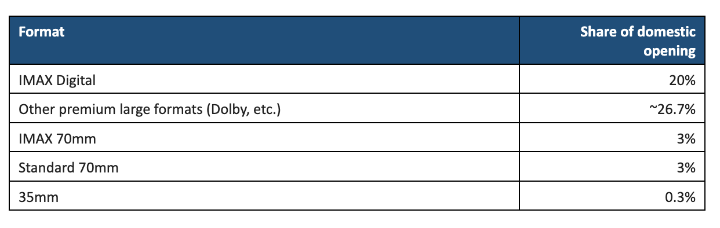
At roughly 0.3% of the domestic opening, 35mm screenings brought in an estimated $374,000 - a mere rounding error next to IMAX Digital's 20% share, and a fraction even of IMAX 70mm's 3%. In other words, if you managed to watch The Odyssey on a 35mm print during opening weekend, you were part of a smaller, more rarefied group than the fans who chased down a 70mm IMAX seat. The format everyone treated as the premium prize was, statistically, three to four times larger than the one almost nobody talked about - although Universal Pictures released a short promo with actor Robert Pattison explaining why audiences should watch The Odyssey on film, 35mm films specifically.
For an exhibition format kept alive by fewer than 300 US venues (most running a single, ageing projector) $374,000 from a handful of engagements is a genuinely respectable result. It is not the largest canvas, nor the most immersive. But scarcity, it turns out, is its own kind of premium. (Figures for 35mm screenings outside the US were not easily available to find.)

Not the biggest screen — the point is the film itself
The appeal here isn't scale. A 35mm print of a movie shot on IMAX cameras can't compete with 70mm for resolution or sheer size. What it offers instead is the thing celluloid has always offered: a photochemical image, grain and flicker and all, projected as a physical object rather than decoded from a file. And that appeal is proving remarkably durable... and, notably, young.
The wider evidence is hard to ignore. The last few years of Best Picture winners have been dominated by films shot photochemically, from Oppenheimer to VistaVision's return in One Battle After Another and 15-perf 65mm in Sinners. First-run features are increasingly given proper film runs - Sinners and Marty Supreme in 70mm, Frankenstein in 35mm. Indie cinemas that never stopped threading reel-to-reel projectors report a surge of new, younger audiences turning up specifically for analogue prints. The same Gen Z that revived film photography - sending manufacturers scrambling and camera shops raiding their back rooms - is now seeking out celluloid on the big screen, drawn by exactly the tangibility and scarcity that digital abundance can't replicate.
The venues keeping first-run film alive
A small number of operators have built this ethos into their programming, and they are worth watching. In Los Angeles, Quentin Tarantino's Vista Theatre reopened in November 2023 with an unusual policy: it programmes first-run films, but only where a 35mm print exists. “We'll show new movies that come out where they give us a film print,” as Tarantino put it - a deliberate gamble, since it asks studios to strike and ship prints they no longer make by default. His nearby New Beverly Cinema remains a 35mm repertory stronghold.
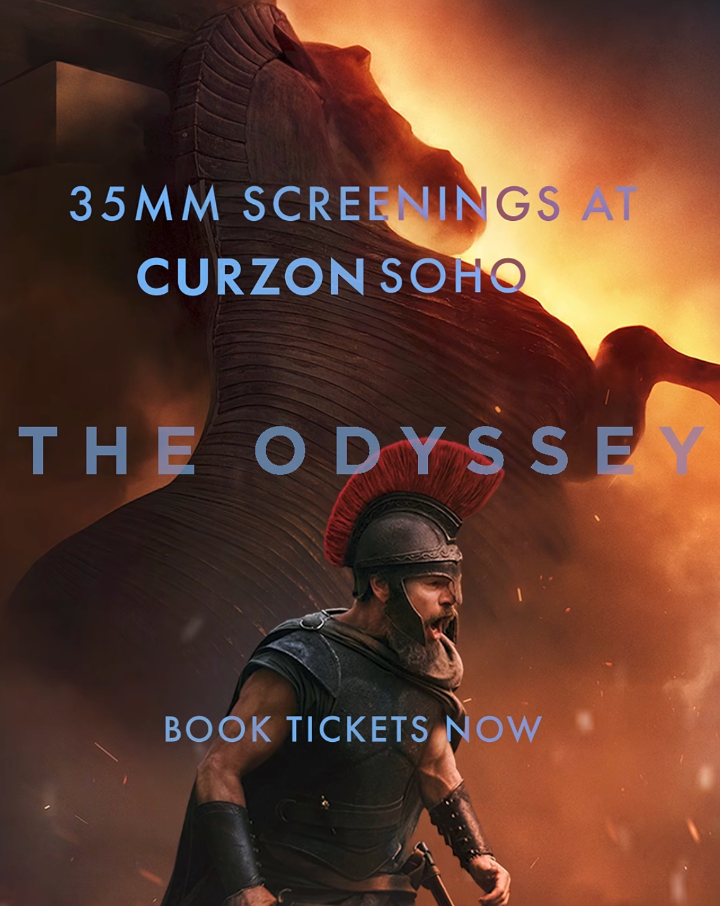
In London, Everyman's Screen on the Green in Islington - opened in 1913, and one of the oldest continuously operating cinemas in the UK - keeps a 35mm projector alongside its laser digital system, pairing new releases and special film events with sofa seating and a bar. Prior to The Odyssey it ran a season of Christopher Nolan films in 35mm. It is a template that reframes celluloid not as a museum piece but as a premium night out. In addition there is 35mm projection in London in Curzon Soho, Picturehouse's Brixton Ritzy, Genesis and the Barbican Centre cinema as well, given Londoners an unusually high choice of venues to watch The Odyssey on film - in addition to the 70mm IMAX screens at the BFI and London Science Museum and non-IMAX 70mm at Picturehouse Central and the Odeon Leicester Square.
Outside of London, The Regent cinema in Christchurch on England's south coast showed the film in 35mm as part of its 'Dirt in the Gate Movies' programme and even included an interval (which may or may not have been sanctioned by Universal Pictures and Sir Christopher.) Also outside London, Picturehouse is showing the film-on-film at the Brighton Duke of York's, Edinburgh Cameo and Cambridge Arts cinemas, while several independent cinemas across the UK are also showing the film in 35mm, including Warwick Arts Centre in Coventry, Derby QUAD, Tyneside Cinema in Newcastle and Dundee Contemporary Arts in Scotland.
What it means for exhibitors
The lesson of The Odyssey isn't that everyone should rush to reinstall 35mm. The economics are unforgiving: prints are expensive, projectors need skilled hands, and the addressable box office - that 0.3% - is tiny in absolute terms. IMAX CEO Rich Gelfond made the same point about scaling 70mm, citing cost and technical constraints even as demand surged.
But the takeaway for the industry is real. Physical film has become a marker of prestige and 'event' cinema exclusivity that audiences - crucially, younger ones - will travel and pay for. The most talked about formats aren't always the rarest, and the rarest can generate outsized cultural attention relative to their box office. For an exhibitor with the right room and the right audience, a single well-kept 35mm projector may be less a nostalgia project than a differentiator: a way to offer something the multiplex down the road, however many digital screens it has, simply cannot.
70mm IMAX may have got all the headlines, but 35mm got the mystique. Both point in the same direction - the pull of film, in every gauge, is proving anything but just nostalgic.
The Odyssey's Rarest Ticket wasn't 70mm IMAX (it was 35mm)